

Have you considered dental implants, only to hesitate once you heard about bone grafting, surgery, months of healing, or how involved the treatment process can become? For some people, those details are enough to put the idea on hold. Small-diameter dental implants can change some of those treatment considerations. Also called mini dental implants, they are narrower than conventional implants. Their smaller size can affect placement, how much bone is needed, and how extensive treatment needs to be. For patients in Ontario, California, that raises an important question: Could a smaller implant change what your treatment would require?
What Has Kept You From Looking Into Dental Implants?
Many people reach this point in their research with a reason they think dental implants may not work for them. Small-diameter dental implants can be worth another look when the concern involves bone, surgery, treatment time, or maybe an existing denture.
I Was Told I Don’t Have Enough Bone.
For many people, the jawbone assessment becomes an unexpected roadblock in the tooth replacement process. We often meet patients who have already been told they do not have enough bone for dental implants. In many cases, though, that conclusion comes from evaluating the jaw for a conventional implant.
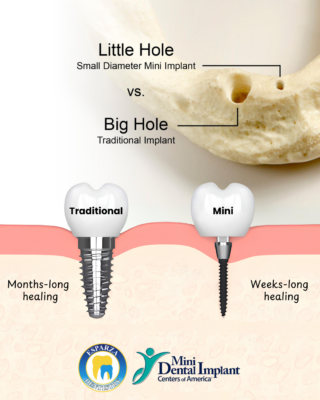
Traditional implants average about 5 millimeters in diameter and need enough surrounding bone for secure placement. If the jaw has become too narrow or has lost too much volume, bone grafting may be recommended before placement. For patients who thought they were ready to replace a tooth, adding another procedure and another healing period can change what treatment looks like.
Small-diameter implants are typically just under 3 millimeters wide. They can sometimes measure around half the size of a conventional implant. As a result, we can often place them in areas with limited bone density and, for qualifying patients, without bone grafting.
I’m Worried Implant Surgery Will Be Too Invasive.
For some people, implant surgery is the main reason they hesitate. Others may have medical considerations that make a less invasive procedure worth exploring.
Placing a conventional dental implant generally requires an incision in the gum tissue to reach the underlying bone. In some cases, the dentist moves the gum tissue back to access the placement site. After inserting the implant, the area may be closed with sutures and given time to heal.
To place a small-diameter implant, we create a tiny opening through the gum and into the bone. We then insert the implant through that opening. The technique typically avoids the larger incision and tissue reflection associated with conventional implant placement.
Because there is often less disruption to the gum tissue and surrounding structures, patients heal faster after placement.
I Don’t Want To Wait Months for Treatment.
Some dental implant treatments can take anywhere from several months to a year. For some patients, that timeline can make treatment feel difficult to commit to.
Small-diameter dental implants may allow us to simplify certain parts of the process, depending on the treatment plan. In some cases, we can place a temporary restoration while the implant heals, so you don’t necessarily have to wait without a tooth or usable restoration during that period.
The final timeline still depends on what we are replacing, how the implant heals, and the restoration you need. Small-diameter implants do not eliminate the healing process, but they may change how we manage the time between placement and the final result.
Can Small-Diameter Dental Implants Cost Less?
It makes sense to assume that a smaller implant would cost less than a conventional implant. But implant diameter is only part of the picture.
Small-diameter dental implants can reduce costs because treatment often involves fewer steps. Their narrower size may make bone grafting unnecessary, and placement is also less invasive. As a result, treatment may require fewer procedures and less healing time.
Each extra procedure adds something to the overall treatment plan. Bone grafting adds another surgery; a longer surgical process adds more treatment time, and additional stages can add more appointments. When some of those steps are not needed, the total cost may be lower.
Still, a lower cost can sometimes make people wonder whether a small-diameter implant is less effective. But price does not answer that question.
The real issue is whether the implant can provide the support needed for the restoration. Some patients need a conventional implant and the additional procedures that come with it. Others may not. Small-diameter implants give us a way to treat certain cases without automatically using a wider implant, bone grafting, or more extensive surgery.
Explore Your Options for Small-Diameter Dental Implants
If surgery, healing time, or cost has kept dental implants off your list, it may be worth finding out whether those same barriers apply to you now. Small-diameter dental implants do not change every treatment plan, but they can change what is necessary for the right patient.
At Esparza Dentistry, we can evaluate your bone, the teeth you need to replace, and what you want treatment to look like before deciding how much treatment you actually need. Schedule a free consultation to explore your options!