As we age, our bodies naturally change. Sometimes, the treatments that once seemed straightforward no longer align with our health needs. It is a reality many of us face, especially those who feel left out of the conversation about tooth replacement. Too often, patients assume that if their health makes conventional implant surgery too demanding, they are out of options altogether. That is not always the case. Minimally invasive dental implants can make implant treatment possible for more people, including older adults with more complex health needs.
At Esparza Dentistry in Ontario, CA, every treatment recommendation begins with the patient. Your overall health, recovery, and long-term comfort are just as important as replacing the missing tooth. Minimally invasive dental implants allow us to offer implant treatment to some patients who may not be good candidates for a more invasive approach.
Can Dental Implants be Minimally Invasive?
When we call a procedure minimally invasive, we mean that it limits unnecessary disruption to your body. Small incisions, or sometimes none at all, allow advanced tools and techniques to deliver treatment with greater care for surrounding tissue.
In dentistry, that can lead to real, measurable benefits. Less trauma to the gums, bone, and nearby tissues often means less swelling, bleeding, and discomfort. Recovery may be easier, and preserving more of the body’s natural structures can help reduce the risk of complications such as infection.
A less demanding procedure can make a meaningful difference for patients who are sensitive to surgery or whose health may make recovery more difficult.
The same approach can be used when replacing missing teeth. Minimally invasive dental implants can restore stability and support a crown, bridge, or denture, without placing the same physical demands on the body as conventional implant surgery.
Minimally Invasive Dental Implants in Ontario, CA
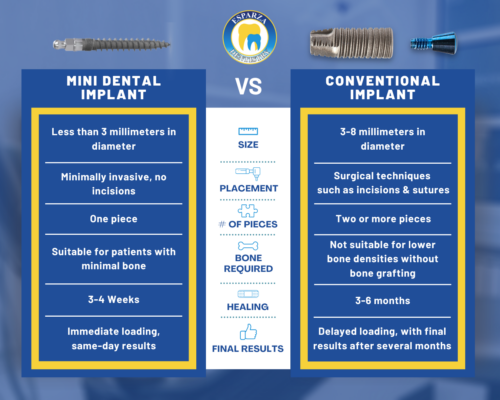
Traditional dental implants have been trusted for decades, but placing them often requires a more complex surgical process. These implants are about 5 millimeters wide, so the dentist needs enough room in the jawbone to position them securely.
Placement commonly begins with flap surgery. The dentist makes an incision in the gum tissue and pulls it back to expose the jawbone. An opening is then created in the bone for the implant post. The gums and bone both need time to recover from this part of the procedure.
Treatment may continue after the implant heals. A second procedure is often needed to uncover the implant and attach the abutment, the connector that supports the replacement tooth. Patients who do not have enough bone width may need bone grafting before implant placement, adding another surgery and another healing period.
Each procedure gives the body more to recover from. The gums must heal from the incision, the bone must heal around the implant, and any grafted area needs time to stabilize. For patients whose health already makes surgery or recovery more difficult, the full process may feel like too much to take on.
How Mini Dental Implants Support a Shorter Recovery
Mini dental implants measure less than 3 millimeters in diameter. Their smaller size changes the placement procedure. We begin with a small pilot opening and carefully thread the implant into the jawbone. In many cases, flap surgery is not necessary.
Mini dental implants also simplify treatment after placement. Traditional implants are made in separate pieces, so the implant is placed first, and the abutment is attached during a later procedure after healing. Mini dental implants combine both parts into a single piece. By removing that intermediate step, treatment often involves fewer surgical stages from beginning to end.
Not every patient is a candidate for every type of implant, and the right treatment always depends on your oral health, bone structure, and overall goals. However, the smaller size and one-piece design of mini dental implants often make treatment possible for patients who may not have been candidates for the traditional implant approach.
Find Out How Mini Dental Implants Can Expand Your Options
Have you ruled out dental implants because surgery seems too demanding? Were you told that limited bone or a health condition could make treatment more difficult? Does replacing your teeth feel important, but the recovery feels like too much?
Mini dental implants may be the answer you have been looking for. Their smaller size and less invasive placement can make implant treatment realistic for some patients who assumed they had already run out of options.
Contact Esparza Dentistry in Ontario, CA, to book a free implant consultation and find out if minimally invasive dental implants can help you.