
Most people researching dental implants are familiar with the basic idea: a small titanium post replaces a missing tooth root and supports an artificial tooth. What often surprises people is how much implants vary. Some are wider, some are narrower, and their construction affects how they’re placed in the jaw. Even the amount of bone needed for treatment changes depending on the implant. At Esparza Dentistry, we offer different types of dental implants because replacing a missing tooth isn’t always straightforward. Someone who has recently lost a tooth may have considerably more jawbone than someone who has worn dentures for 20 years. Implant size, design, and placement techniques give us options for addressing these differences.
What Are the Different Types of Dental Implants?
Dental implants are small posts, typically made from titanium, that we place in the jawbone to support replacement teeth. Over time, the surrounding bone bonds with the implant surface through a biological process called osseointegration. The implant supports a dental crown, bridge, or denture.
Although implants share this basic function, they vary in diameter and construction.
Traditional Dental Implants
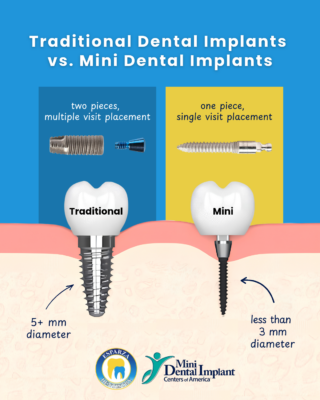
Traditional dental implants are generally around 5 millimeters in diameter, although different sizes are available. Most use a two-piece design: an implant body and a separate connector called an abutment.
We place the implant body into the jawbone and connect the abutment to the implant and the final restoration.
Traditional implants have a long history of successful use in restorative dentistry. However, their wider diameter requires sufficient bone volume for placement. Patients with significant bone loss may need additional treatment, such as bone grafting, before receiving these implants.
Small-Diameter Dental Implants
Small-diameter implants occupy less space in the jaw than conventional implants. Their narrower construction gives us additional options when the available bone is limited, or the space between neighboring teeth is particularly tight.
Small-diameter implants come in different widths and designs. Some have separate abutments, while others incorporate the connector into the implant body.
The appropriate diameter depends on the available bone, the position of the missing teeth, and the restoration the implant will support.
Mini dental implants are among the narrowest implants available, measuring less than 3 millimeters in diameter. A mini implant typically consists of one solid piece, with the implant body and connector manufactured as one unit.
We generally place these implants through a small pilot opening in the gum and jawbone. The technique often eliminates the need for incisions, stitches, and extensive healing periods.
How Does Jawbone Loss Affect Your Implant Options?
After losing a tooth, the jawbone in that area gradually shrinks. Natural tooth roots transfer pressure from chewing into the surrounding bone, providing stimulation that helps maintain its structure. Without that stimulation, the body gradually breaks down bone tissue through a process called resorption. Over time, the jawbone may become shorter, narrower, or both.
Bone loss sometimes complicates dental implant placement. Traditional implants are relatively wide, so we need sufficient bone around each implant to keep it stable. Patients who have lost considerable bone may require a bone graft before receiving traditional implants. Grafting adds volume to the jaw, but it also introduces additional treatment and healing time.
Mini dental implants offer another possibility. Their narrow diameter requires less space in the jawbone, which makes them particularly useful when bone width is limited. We may be able to place mini implants in areas that would otherwise require grafting for a traditional implant.
The remaining bone still needs sufficient height, density, and strength to support the implants. We evaluate these conditions, along with the location of nearby nerves and sinuses, before recommending treatment.
How Do Implant Types Affect the Cost of Treatment?
Dental implant costs reflect the materials, appointments, and additional treatment needed to restore missing teeth.
Traditional implants often require multiple components and a longer treatment timeline. Additional treatment, including bone grafting, may increase the total expense.
Mini dental implants generally cost less because their one-piece construction reduces the number of components. Placement is also typically less involved, and many patients avoid the expense of bone grafting.
However, the implant represents only part of the overall cost.
Replacing one tooth with a crown differs considerably from replacing an entire arch of teeth. The number of implants, restoration materials, and condition of the remaining teeth all influence the final price.
At Esparza Dentistry, we discuss treatment costs and available financing options during your consultation.
Learn More About Different Types of Dental Implants at Esparza Dentistry
Being told you don’t have enough bone for dental implants is frustrating, especially when you’ve already spent years dealing with missing teeth or uncomfortable dentures. But an implant’s size and design may change which treatments are available to you. At Esparza Dentistry, we offer several types of dental implants, including narrower options for patients with limited jawbone.
Schedule a free dental implant consultation to learn which options are right for you!