
Traditional dental implants have changed the way dentists replace missing teeth. They provide a stable foundation for replacement teeth, help preserve jawbone, and offer a long-term solution for patients who have lost one or more teeth. However, traditional implants aren’t suitable for everyone. Some patients lack the bone needed to support them, while others are concerned about surgery, recovery time, or the cost of treatment.
Mini dental implants offer another option. Their smaller diameter and less invasive placement method can make tooth replacement possible for patients who may not qualify for traditional dental implants. Both types have their advantages, and understanding their differences can help you make an informed decision about your dental care.
What Are Traditional Dental Implants?
Traditional dental implants are titanium posts that we place in the jawbone to replace missing tooth roots. They provide a stable foundation for replacement teeth and help maintain jawbone density by transferring the forces of chewing to the surrounding bone.
Most traditional dental implants have three components:
- Implant post: A small, screw-shaped titanium post that sits in the jawbone and serves as an artificial tooth root.
- Abutment: A connector that attaches to the implant post and supports the replacement tooth.
- Restoration: A crown, bridge, or denture that replaces the visible portion of your missing teeth.
After placement, the surrounding jawbone gradually grows into direct contact with the implant surface through a biological process called osseointegration. This connection helps secure the implant and enables it to withstand the forces of everyday chewing.
Traditional dental implants are generally around 5 millimeters in diameter, although sizes vary. Their width and placement requirements mean patients need sufficient jawbone to support them. Some patients may require bone grafting before implant placement, particularly if they have experienced significant bone loss.
Traditional Dental Implants vs. Mini Dental Implants
Traditional dental implants and mini dental implants serve the same general purpose: replacing missing teeth with restorations supported by the jawbone. However, their differences in size and construction affect how we place them, how much bone they require, and how long treatment may take.
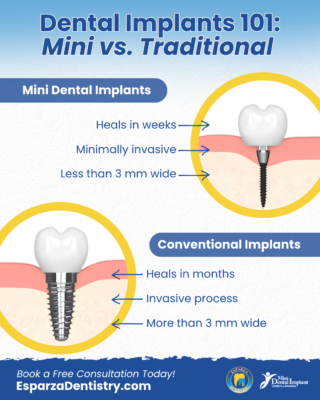
Traditional dental implants are typically around 5 millimeters wide and have two separate components: the implant post and the abutment. Their larger diameter requires adequate jawbone width and height for secure placement. Patients who have lost significant bone may need a bone graft to rebuild the area before receiving implants. Treatment also generally involves a healing period of several months while the implant integrates with the surrounding bone.
Mini dental implants measure less than 3 millimeters in diameter and typically feature a one-piece design that combines the implant post and abutment. Their smaller size makes them particularly useful in areas where the jawbone is too narrow for a conventional implant. In many cases, we can place mini implants through a small opening in the gums without making a large incision or using stitches. Bone grafting is also less frequently necessary, and some restorations can be attached much sooner.
Both types of dental implants can provide long-term tooth replacement, but neither is suitable for every situation. Traditional implants may be preferable when greater implant diameter is needed to support a restoration, while mini implants can offer advantages when bone width is limited or a less invasive placement method is appropriate. Your oral health, available bone, and the type of replacement teeth you need all influence which option our team recommends.
Mini Implants: A Cost-Effective Alternative
Mini dental implants simplify the process and redefine efficiency. By eliminating the need for procedures like bone grafting and offering a minimally invasive placement method, they reduce extra appointments, recovery time, and procedural costs. These advantages work together, creating a ripple effect that makes mini implants a more economical choice overall.
Think of it like solving a math problem: if traditional implants require added steps to prepare the jawbone, the equation naturally becomes longer and more complex. Mini dental implants streamline the formula. Their smaller size and simpler placement remove many extra variables, reducing time and expense. The result? A solution that’s not only more accessible but also kinder to your wallet—all while maintaining the same transformative benefits that dental implants are known for.
Learn More About Mini Dental Implants Today
Your smile is a key part of your story, and restoring it should feel empowering and within reach. Mini dental implants open the door to advanced care that is simpler, more accessible, and built around your comfort. Their innovative design and minimally invasive approach offer a transformative way to support your dental health and well-being.
Contact us today to schedule a free consultation and explore your options!